
Advent Meditation 2025, Week 4
Advent Meditation, Fourth Week of Advent 2025
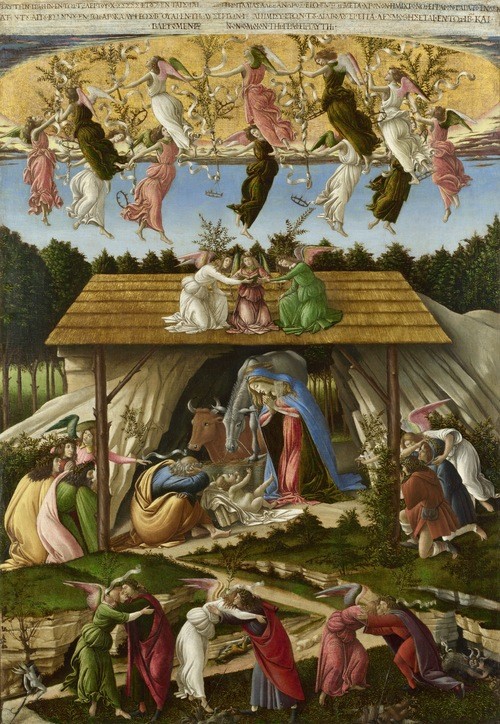
Sandro Botticelli (1445-1510)1, Mystic Nativity (1500)2, housed in the National Gallery, London. Charles Dempsey in Grove Art Online: “The painting bears a Greek inscription identifying its subject as the Second Coming of Christ as foretold in the Revelation of St. John and announcing Christ’s coming in the year 1500 CE during the tribulations then afflicting the Italian peninsula. … The colors are those traditionally assigned to Charity (red), Faith (white), and Hope (green), and it had been Joachim3 who identified the three realms, or stages, of the world with an Old Testament age of Hope, a New Testament age of Faith, and a post-Apocalyptic age of Charity, or perfect Love, the future age initiated by the Second Coming of Christ. He named this as the age of the eternal Evangel (the book held by the central angel painted by Botticelli on the roof of the shed), when Hope and Faith would come together in perfect Charity, and he imagined that with the Second Coming of Christ and the expulsion of the devil from the world heaven would descend to earth and join with it, and men and angels would live together for a thousand years in a state of Christian love, until the end of the world in the day of the Last Judgment.”
So much to draw the eye in Botticelli’s painting, from the tiny in stature devils, looking like pestilential bedbugs out to wreck a good night’s sleep (see them, those pallid winged creatures along the bottom of the painting?) to that circle of angels, dancing angels, in the sky above the Stable – a perfect expression of “Joy of Heav’n to Earth come down”. But what most catches my eye is the upstretched arm of the child Jesus. We so often articulate the religious quest as learning how, consistently, to stretch out our arms toward God, which too often causes us to overlook that the Incarnation has nothing to do with our reaching toward God, but it has everything to do with a gesture of Love that “comes down”, that is all God’s initiative, God reaching towards us.
Abraham Joshua Heschel (1907-1972) – “The meaning of awe is to realize that life takes place under wide horizons, horizons that range beyond the span of an individual life or even the life of a nation, a generation, or an era. Awe enables us to perceive in the world intimations of the divine, to sense in small things the beginning of infinite significance, to sense the ultimate in the common and the simple; to feel in the rush of the passing the stillness of the eternal.”
NOTE: For the best copy of this Meditation, with all formatting in place, click here for the PDF:
Some Musical Versions of the Following Text
The Choir of King’s College, Cambridge, The World of Favourite Hymns (released 1986); The Tabernacle Choir at Temple Square, Let Us All Press On: Hymns of Praise and Inspiration (released 2019); Conspirare, directed by Craig Hella Johnson, Close to You – Carillon Christmas 2019 (released 2021); Choir of Trinity College Melbourne, directed by Michael Leighton Jones, Abide With Me: A Treasury of Classic Hymns (released 2006).
Text
Charles Wesley (1707-1788)4, “Love divine, all loves excelling” (1747)
The Choir of King’s College, Cambridge, The World of Favourite Hymns (released 1986); The Tabernacle Choir at Temple Square, Let Us All Press On: Hymns of Praise and Inspiration (released 2019); Conspirare, directed by Craig Hella Johnson, Close to You – Carillon Christmas 2019 (released 2021); Choir of Trinity College Melbourne, directed by Michael Leighton Jones, Abide With Me: A Treasury of Classic Hymns (released 2006).
Text
Charles Wesley (1707-1788)4, “Love divine, all loves excelling” (1747)
1. Love divine, all loves excelling,
Joy of Heav'n to Earth come down,
Fix in us thy humble dwelling,
All thy faithful mercies crown;
Jesus, thou art all compassion,
Pure, unbounded love thou art;
Visit us with thy salvation,
Enter ev'ry trembling heart.
2. Breathe, O breathe thy loving Spirit
Into ev'ry troubled breast;
Let us all in thee inherit,
Let us find thy promised rest;
Take away our love of sinning;
Alpha and Omega be;
End of faith as its beginning,
Set our hearts at liberty.
3. Come, Almighty to deliver;
Let us all thy grace receive;
Suddenly return, and never,
Never more thy temples leave.
Thee we would be always blessing,
Serve thee as thy host above,
Pray, and praise thee without ceasing,
Glory in thy perfect love.
4. Finish, then, thy new creation;
Pure and spotless let us be;
Let us see thy great salvation
Perfectly restored in thee;
Changed from glory into glory
Till in Heav'n we take our place,
Till we cast our crowns before thee,
Lost in wonder, love, and praise!
A Close Reading of the Text
Love – It is a bold start to have begun with this single English noun that names the very heart of the Triune God – “Pure, unbounded love thou art”. “Love” is the greatest of the Names of God and an important Trinitarian elucidation of that so famous, but very solitary Name – “I am” – revealed to Moses at the Burning Bush (Exodus 3:13-15) –
What the name “Love” adds to the “I am” is the relational identity of God as a community of three divine Persons. Love is not only the greatest of the Names, but it also expresses the very core God’s meaning, as Julian of Norwich (c. 1343 – c. 1416) eventually understood, and who so eloquently expressed it:
Love divine, all loves excelling, Joy of Heav'n to Earth come down – In the first stanza, Wesley contemplates the stunning contrast, and the completely unexpected reality of the Incarnation!7, when “high” realities (exalted, divine) “fit” themselves into what is “low” (human, humble, of little consequence on its own). How can something so vast and real “fit” – “enter every trembling heart”? Why would God freely, deliberately choose to become “small”?
Notice how the mystery of the Incarnation is being expressed in the rhymes. We observe: “all loves excelling” (high) rhymes with “humble dwelling” (low); “come down” (low) rhymes with “crown” (high); “compassion” (high) rhymes with “salvation” (low); “thou art” (high) rhymes with “trembling heart” (low).
Sometimes we forget that during the first thousand years of the Church’s existence, it was the Incarnation (God choosing to become human) that occupied the attention of its profoundest theological thinkers, not the passion, death, and resurrection of Jesus (except these understood as a further deepening of the mystery of the Incarnation). It was in the second thousand years that the Cross would come to captivate the attention of our greatest thinkers.
Love – It is a bold start to have begun with this single English noun that names the very heart of the Triune God – “Pure, unbounded love thou art”. “Love” is the greatest of the Names of God and an important Trinitarian elucidation of that so famous, but very solitary Name – “I am” – revealed to Moses at the Burning Bush (Exodus 3:13-15) –
13 Moses then said to God, ‘Look, if I go to the Israelites and say to them, “The God of your ancestors has sent me to you,” and they say to me, “What is his name?” what am I to tell them?’ 14 God said to Moses, ‘I am he who is.’5
What the name “Love” adds to the “I am” is the relational identity of God as a community of three divine Persons. Love is not only the greatest of the Names, but it also expresses the very core God’s meaning, as Julian of Norwich (c. 1343 – c. 1416) eventually understood, and who so eloquently expressed it:
So, I was taught that love is our Lord’s meaning. And I saw very certainly in this and in everything that before God made us, he loved us, which love was never abated and never will be. And in this love, he has done all his works, and in this love he has made all things profitable to us, and in this love our life is everlasting. In our creation we had beginning, but the love in which he created us was in him from without beginning. In this love we have our beginning, and all this shall we see in God without end.6
Love divine, all loves excelling, Joy of Heav'n to Earth come down – In the first stanza, Wesley contemplates the stunning contrast, and the completely unexpected reality of the Incarnation!7, when “high” realities (exalted, divine) “fit” themselves into what is “low” (human, humble, of little consequence on its own). How can something so vast and real “fit” – “enter every trembling heart”? Why would God freely, deliberately choose to become “small”?
St. Ignatius of Loyola (1491-1556), Spiritual Exercises, on “the Contemplation of the Incarnation”- {102} 1 - The First Prelude is to survey the history of the matter I am to contemplate. Here it is how the three Divine Persons gazed on the whole surface or circuit of the world, full of people; and how, seeing that they were all going down into Hell, they decide in their eternity that the Second Person should become a human being, in order to save the human race. And thus, when the fullness of time had come, they sent the angel St. Gabriel to Our Lady.
Notice how the mystery of the Incarnation is being expressed in the rhymes. We observe: “all loves excelling” (high) rhymes with “humble dwelling” (low); “come down” (low) rhymes with “crown” (high); “compassion” (high) rhymes with “salvation” (low); “thou art” (high) rhymes with “trembling heart” (low).
Sometimes we forget that during the first thousand years of the Church’s existence, it was the Incarnation (God choosing to become human) that occupied the attention of its profoundest theological thinkers, not the passion, death, and resurrection of Jesus (except these understood as a further deepening of the mystery of the Incarnation). It was in the second thousand years that the Cross would come to captivate the attention of our greatest thinkers.
I myself have long wondered what great good might have come to our theological understanding, and spiritual practices, if we had considered the Paschal Mystery (the passion, death, and resurrection, and ascension of Christ) as the completion of the Incarnation rather than as we awkwardly, and too often, consider the Cross as having been caused (as in forced God to act) by “our faults, our faults, our most grievous faults.”8
Breathe, O breathe thy loving Spirit Into ev'ry troubled breast – I have noticed that sometimes when a person is suffering a calamity in his or her life – the haunting of memories; the startling jolt when experiencing cruelty; feeling overwhelmed by the human taste for horrors and our cunning ability to spawn them, etc. – he or she can have a hard time breathing, catching his or her breath. I see him or her laboring under a terrible compression of the chest, a psychological binding around his or her heart. “I can’t breathe!” It is in such a person, in such a state, that these words – “Breathe, O breathe thy loving Spirit” – is exactly what one needs.
Take away our love of sinning – Such an unsettling frankness by the poet. It is a perceptiveness about human beings that caused Jesus one night to speak of the same thing, when a learned man come to talk to him:
It is a useful and a mature insight to be given us by God, and usually through the words of a teacher whom we trust, that we really do not “hate” our sins but enjoy them, or as Wesley says with a particular sharpness, we love them.
I have rarely in my life met a person, in any context, who said outright, and with genuine embarrassment, that he or she sinned (in some way) because he or she liked doing so! It is most consistently in addiction recovery programs, such as Alcoholics Anonymous, that persons come to realize the grace in, and the necessity of, practicing an honesty so starkly direct and on target … and doing it with others similarly committed to such honesty. What would you or I feel if Jesus, looking directly at us with those beautiful eyes, said, “You are aware, aren’t you, that in this habit of yours you prefer darkness to the light?”
Breathe, O breathe thy loving Spirit Into ev'ry troubled breast – I have noticed that sometimes when a person is suffering a calamity in his or her life – the haunting of memories; the startling jolt when experiencing cruelty; feeling overwhelmed by the human taste for horrors and our cunning ability to spawn them, etc. – he or she can have a hard time breathing, catching his or her breath. I see him or her laboring under a terrible compression of the chest, a psychological binding around his or her heart. “I can’t breathe!” It is in such a person, in such a state, that these words – “Breathe, O breathe thy loving Spirit” – is exactly what one needs.
Take away our love of sinning – Such an unsettling frankness by the poet. It is a perceptiveness about human beings that caused Jesus one night to speak of the same thing, when a learned man come to talk to him:
John 3:19-20 (NJB):
19 And the judgement is this:
though the light has come into the world
people have preferred
darkness to the light
because their deeds were evil.
20 And indeed, everybody who does wrong
hates the light and avoids it,
to prevent his actions from being shown up.9
It is a useful and a mature insight to be given us by God, and usually through the words of a teacher whom we trust, that we really do not “hate” our sins but enjoy them, or as Wesley says with a particular sharpness, we love them.
I have rarely in my life met a person, in any context, who said outright, and with genuine embarrassment, that he or she sinned (in some way) because he or she liked doing so! It is most consistently in addiction recovery programs, such as Alcoholics Anonymous, that persons come to realize the grace in, and the necessity of, practicing an honesty so starkly direct and on target … and doing it with others similarly committed to such honesty. What would you or I feel if Jesus, looking directly at us with those beautiful eyes, said, “You are aware, aren’t you, that in this habit of yours you prefer darkness to the light?”
Suddenly return, and never, Never more thy temples leave – These lines reference the Christian understanding of the indwelling of God – the Holy Spirit – within each of us, as if in a holy Temple. As a Catholic boy I was taught that the Sacrament of Confirmation made each of us a “Temple of the Holy Spirit”. (We had no idea what this meant of course, because, I believe, young people already have a much more intimate awareness of the presence of God than the awkward theological language of “Temple” is expressing.) One of the most beautiful expressions of this “incarnation” of the Holy Spirit within each of us comes at the end of the most famous sermon that C.S. Lewis ever preached, delivered from the pulpit in St. Mary the Virgin on the High Street in Oxford, on 8 June 1942, on a Monday, eighty-three and a half years ago. It bore the title, “The Weight of Glory”10, and it concludes in this way:
There are no ordinary people. You have never talked to a mere mortal. Nations, cultures, arts, civilization—these are mortal, and their life is to ours as the life of a gnat. But it is immortals whom we joke with, work with, marry, snub, and exploit—immortal horrors or everlasting splendours. This does not mean that we are to be perpetually solemn. We must play. But our merriment must be of that kind (and it is, in fact, the merriest kind) which exists between people who have, from the outset, taken each other seriously—no flippancy, no superiority, no presumption. And our charity must be a real and costly love, with deep feeling for the sins in spite of which we love the sinner—no mere tolerance or indulgence which parodies love as flippancy parodies merriment. Next to the Blessed Sacrament itself, your neighbour is the holiest object presented to your senses. If he is your Christian neighbour he is holy in almost the same way, for in him also Christ vere latitat—the glorifier and the glorified, Glory Himself, is truly hidden.
An Advent Prayer
St. John Henry Newman (1801-1890), Doctor of the Church –
St. John Henry Newman (1801-1890), Doctor of the Church –
O my God, whatever is nearer to me than Thou, things of this earth, and things more naturally pleasing to me, will be sure to interrupt the sight of Thee, unless Thy grace interfere.11 Keep Thou my eyes, my ears, my heart, from any such miserable tyranny. Keep my whole being fixed on Thee. Let me never lose sight of Thee; and while I gaze on Thee, let my love of Thee grow more and more every day.12
Notes
1 Grove Art Online (Oxford) at “Botticelli, Sandro” by Charles Dempsey - Botticelli (It.: “a small wine cask”), a nickname taken from that of his elder brother, was the son of a tanner. He may briefly have trained as a goldsmith but soon entered the studio in Florence of Fra Filippo Lippi, who taught him painting. He is mentioned as an independent master in 1470 (though he doubtless arrived at this status earlier). … Botticelli’s extraordinary mastery of drawing and elastic contour became progressively simplified and economized, occasionally producing even a crudeness of effect; his colors, notably his greens, yellows, and reds, became brighter and purer in hue; and the action of his profoundly felt dramas was staged in an abstract and otherworldly environment that is the imaginative counterpart to the simple backdrops designed for a mystery play. There is no artistic ornament conceived for its own sake, and all is calculated to enhance a single narrative and emotional effect.”
2 To study this painting more closely: https://commons.wikimedia.org/wiki/File:Mystic_Nativity,_Sandro_Botticelli.jpg.
3 Joachim of Fiore (jōʹəkĭm), c.1132–1202, Italian Cistercian monk. He was abbot of Corazzo, Italy, but withdrew into solitude. He left scriptural commentaries prophesying a new age. In his “Age of the Spirit” the hierarchy of the church would be unnecessary, and infidels would unite with Christians. Joachim’s works had a vogue in the 13th and the 14th cent.; many, especially the extremist Spiritual Franciscans, acclaimed him as a prophet. Dante places him in Paradise. [Paul Lagassé, Columbia University, in The Columbia Encyclopedia (New York; Detroit: Columbia University Press; Sold and distributed by Gale Group, 2000).]
2 To study this painting more closely: https://commons.wikimedia.org/wiki/File:Mystic_Nativity,_Sandro_Botticelli.jpg.
3 Joachim of Fiore (jōʹəkĭm), c.1132–1202, Italian Cistercian monk. He was abbot of Corazzo, Italy, but withdrew into solitude. He left scriptural commentaries prophesying a new age. In his “Age of the Spirit” the hierarchy of the church would be unnecessary, and infidels would unite with Christians. Joachim’s works had a vogue in the 13th and the 14th cent.; many, especially the extremist Spiritual Franciscans, acclaimed him as a prophet. Dante places him in Paradise. [Paul Lagassé, Columbia University, in The Columbia Encyclopedia (New York; Detroit: Columbia University Press; Sold and distributed by Gale Group, 2000).]
4 From Hymnary.org taken from John Julian, Dictionary of Hymnology (1907) - Charles Wesley, M.A. was the great hymn-writer of the Wesley family, perhaps, taking quantity and quality into consideration, the great hymn-writer of all ages. Charles Wesley was the youngest son and 18th child of Samuel and Susanna Wesley, and was born at Epworth Rectory, Dec. 18, 1707. In 1716 he went to Westminster School, being provided with a home and board by his elder brother Samuel, then usher at the school, until 1721, when he was elected King's Scholar, and as such received his board and education free. In 1726 Charles Wesley was elected to a Westminster studentship at Christ Church, Oxford, where he took his degree in 1729, and became a college tutor. In the early part of the same year his religious impressions were much deepened, and he became one of the first band of "Oxford Methodists." … As a hymn-writer Charles Wesley was unique. He is said to have written no less than 6500 hymns, and though, of course, in so vast a number some are of unequal merit, it is perfectly marvellous how many there are which rise to the highest degree of excellence. His feelings on every occasion of importance, whether private or public, found their best expression in a hymn.
5 The New Jerusalem Bible (New York; London; Toronto; Sydney; Auckland: Doubleday, 1990), Ex 3:13–14.
5 The New Jerusalem Bible (New York; London; Toronto; Sydney; Auckland: Doubleday, 1990), Ex 3:13–14.
6 Julian of Norwich, Julian of Norwich: Showings, ed. Richard J. Payne, trans. Edmund Colledge and James Walsh, The Classics of Western Spirituality (Mahwah, NJ: Paulist Press, 1978), 342–343.
7 Fr. Karl Rahner, SJ (1904-1984), one of the top five or three greatest Christian theologians of the 20th century, wrote that at the center of reality are three great Mysteries (not problems to be solved, but mysteries through which to walk, never coming to the full depth of them). The three Mysteries are the Trinity, the Incarnation, and Grace.
7 Fr. Karl Rahner, SJ (1904-1984), one of the top five or three greatest Christian theologians of the 20th century, wrote that at the center of reality are three great Mysteries (not problems to be solved, but mysteries through which to walk, never coming to the full depth of them). The three Mysteries are the Trinity, the Incarnation, and Grace.
8 These words are taken from the Penitential Rite through which Catholic worshippers pass from arriving at Church for the Eucharistic Service to being ready to be still and to listen to the Word of God proclaimed from the pulpit.
9 The New Jerusalem Bible (New York; London; Toronto; Sydney; Auckland: Doubleday, 1990), Jn 3:19–20.
10 Lewis’ sermon is developing the biblical text, 2 Corinthians 4: 17 The temporary, light burden of our hardships is earning us forever an utterly incomparable, eternal weight of glory, 18 since what we aim for is not visible but invisible. Visible things are transitory, but invisible things eternal. [The New Jerusalem Bible (New York; London; Toronto; Sydney; Auckland: Doubleday, 1990), 2 Co 4:17–18.]
9 The New Jerusalem Bible (New York; London; Toronto; Sydney; Auckland: Doubleday, 1990), Jn 3:19–20.
10 Lewis’ sermon is developing the biblical text, 2 Corinthians 4: 17 The temporary, light burden of our hardships is earning us forever an utterly incomparable, eternal weight of glory, 18 since what we aim for is not visible but invisible. Visible things are transitory, but invisible things eternal. [The New Jerusalem Bible (New York; London; Toronto; Sydney; Auckland: Doubleday, 1990), 2 Co 4:17–18.]
11 “unless Thy Grace interfere” – Such a beautiful and unexpected way of speaking of divine Grace – as “interference”. The Oxford English Dictionary at “to interfere” – “2.a. – 1609 – intransitive. Hence, of things generally: To strike against each other; to come into physical collision; to collide or clash, so as to hamper or hinder each other; to get in each other's way, cross each other's path.” When we have gotten “stuck” spiritually or psychologically or even socially, the arrival of an “interfering grace” seems a great kindness indeed.
12 Newman, John Henry. The Essential Cardinal Newman Collection: Prayers, Meditations, and Other Spiritual Writings (p. 34). Kindle Edition.
12 Newman, John Henry. The Essential Cardinal Newman Collection: Prayers, Meditations, and Other Spiritual Writings (p. 34). Kindle Edition.
Recent
Categories
Tags
Archive
2026
January
February
March
October
2025
January
March
June
October
2024
January
March
September
October
2023
March
November
2022
2021
1 Comment
Thank you and Merry Christmas, Rick.