
Lenten Meditation, First Sunday of Lent 2026
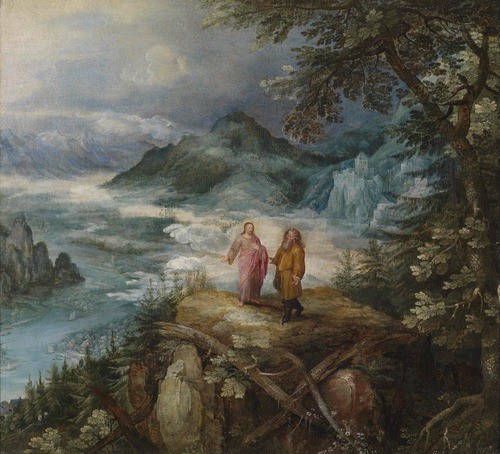
The Temptation of Christ (1600)1 by Jan Brueghel the Elder (1568-1625)
For the best copy of this Meditation, with all formatting in place, click here for the PDF:
Seeing the Painting
Some painters pack depictions of all three temptations into a single frame. Brueghel the Elder here focuses on only the third temptation. Why do you suppose? Did he guess that Satan judged that this temptation would be the one that would finally trip up Jesus? Perhaps Satan, getting distressed at his failure so far, brought into play what he considered the one thing that Jesus could not resist? What is it, do you think, that Satan, assessing Jesus with a conviction born of malice, considered Jesus’ greatest weakness, where He was most vulnerable to temptation? What exactly was this third temptation?
Pay particular attention to the comprehensive haziness Brueghel the Elder paints into the scene, giving the painting a dream-like look. Or has he not brilliantly figured out how to capture in paint a wile of Satan, who tempts us by making what should be perfectly clear to us appear unclear, vague, making us unable to perceive clearly what we are choosing? It is as if the artist is painting the very nature of all temptations of Satan - obfuscation?
Matthew 4 (NJB): 8 Next, taking him to a very high mountain, the devil showed him all the kingdoms of the world and their splendour. 9 And he said to him, ‘I will give you all these, if you fall at my feet and do me homage.’ 10 Then Jesus replied, ‘Away with you, Satan!2
Some painters pack depictions of all three temptations into a single frame. Brueghel the Elder here focuses on only the third temptation. Why do you suppose? Did he guess that Satan judged that this temptation would be the one that would finally trip up Jesus? Perhaps Satan, getting distressed at his failure so far, brought into play what he considered the one thing that Jesus could not resist? What is it, do you think, that Satan, assessing Jesus with a conviction born of malice, considered Jesus’ greatest weakness, where He was most vulnerable to temptation? What exactly was this third temptation?
The Oxford English Dictionary at the noun “wile” – 1.a. – 1154 – A crafty, cunning, or deceitful trick; a sly, insidious, or underhand artifice; a stratagem, ruse. Formerly sometimes in somewhat wider sense: A piece of deception, a deceit, a delusion.
Pay particular attention to the comprehensive haziness Brueghel the Elder paints into the scene, giving the painting a dream-like look. Or has he not brilliantly figured out how to capture in paint a wile of Satan, who tempts us by making what should be perfectly clear to us appear unclear, vague, making us unable to perceive clearly what we are choosing? It is as if the artist is painting the very nature of all temptations of Satan - obfuscation?
The Oxford English Dictionary at “to obfuscate” – 1. To cast into darkness or shadow; to cloud [see Brueghel’s painting], to obscure.
Quotes
Romano Guardini (1885-1968) - Man has duped himself by his very cleverness; mistaking means for ends, he has degenerated from a master of the machine to a slave-mechanic. Such deterioration is an expression of the demonic, as is much else. Naturally, it is not easy to see clearly, to differentiate with nicety when our own eyes are blinded. Blurred vision, confused action, coldness of heart and falsely directed will—all are part of the same labyrinth. He who is caught in it sees only objects, facts, consequences, logic. He does not see the enemy. Jesus brought Satan to a standstill. He alone was able to stare him down. To the extent that we succeed in looking with Christ’s eyes, we too shall see him; to the extent that Christ’s heart and spirit become alive in us, we shall dominate him. The clever will of course smile at this. [Guardini, Romano. The Lord (p. 139). Kindle Edition. My emphases.]
Dame Iris Murdoch (1919-1999)3 – “The self, the place where we live, is a place of illusion. Goodness is connected with the attempt to see the unself… to pierce the veil of selfish consciousness and join the world as it really is.”
Thoughts
We can be surprised when a person or persons perceive something, the same something that others perceive, yet arrive at such a different conclusion as to its nature and intent. Consider in the long course of human events, how regularly people have fallen for the seduction of human monsters, have freely turned over their freedom to them.
No one (if Aristotle was right about temptation) ever chooses a monster as monster; no one ever deliberately chooses to have him or her reign, so that savagery thrives or, as St. John Paul II articulated, so that a culture of death may establish itself as what “normal” now will be.
We must learn, in this Lenten season of repentance and with a relentless and honest self-assessment, that people (that means each of us) choose what they believe to be good (or at least better than what they have). How can we fault them for this? We should not. They do not see the Enemy (i.e., the enemy of our human nature) … as we, more than we like to admit, do not see him either, the Enemy whose superpower is to lie.
Romano Guardini (1885-1968) - Man has duped himself by his very cleverness; mistaking means for ends, he has degenerated from a master of the machine to a slave-mechanic. Such deterioration is an expression of the demonic, as is much else. Naturally, it is not easy to see clearly, to differentiate with nicety when our own eyes are blinded. Blurred vision, confused action, coldness of heart and falsely directed will—all are part of the same labyrinth. He who is caught in it sees only objects, facts, consequences, logic. He does not see the enemy. Jesus brought Satan to a standstill. He alone was able to stare him down. To the extent that we succeed in looking with Christ’s eyes, we too shall see him; to the extent that Christ’s heart and spirit become alive in us, we shall dominate him. The clever will of course smile at this. [Guardini, Romano. The Lord (p. 139). Kindle Edition. My emphases.]
Dame Iris Murdoch (1919-1999)3 – “The self, the place where we live, is a place of illusion. Goodness is connected with the attempt to see the unself… to pierce the veil of selfish consciousness and join the world as it really is.”
Thoughts
The Oxford English Dictionary at “to tempt” – I.1.a. - 1382–1700 - To try, make trial of, put to the test or proof; to try the quality, worth, or truth of. II.4.a. - c1230 – transitive. To try to attract, to entice (a person) to do evil; to present attractions to the passions or frailties of; to allure or incite to evil with the prospect of some pleasure or advantage. Etymology: < Latin temptāre, temtāre to handle, touch, feel, try the strength of, put to the test, try, attempt.
We can be surprised when a person or persons perceive something, the same something that others perceive, yet arrive at such a different conclusion as to its nature and intent. Consider in the long course of human events, how regularly people have fallen for the seduction of human monsters, have freely turned over their freedom to them.
The Oxford English Dictionary at “monster” – 1.a. - c1375 – Originally: a mythical creature which is part animal and part human, or which combines elements of two or more animal forms, and is frequently of great size and ferocious appearance. Later, more generally: any imaginary creature that is large, ugly, and frightening.
No one (if Aristotle was right about temptation) ever chooses a monster as monster; no one ever deliberately chooses to have him or her reign, so that savagery thrives or, as St. John Paul II articulated, so that a culture of death may establish itself as what “normal” now will be.
We must learn, in this Lenten season of repentance and with a relentless and honest self-assessment, that people (that means each of us) choose what they believe to be good (or at least better than what they have). How can we fault them for this? We should not. They do not see the Enemy (i.e., the enemy of our human nature) … as we, more than we like to admit, do not see him either, the Enemy whose superpower is to lie.
But we can fault them, and ourselves, for falling for temptations that make hazy what should be perfectly clear to us, and for the corruption of relationships that ensues, the destruction of trust. We rightly do not deny a person’s right to choose, but we do have the right to hold him or her accountable for what comes of his or her choice. The German nation must still look with horror at what they chose, or allowed, during that part of their 20th century history. “How did we not see what was happening? What were we thinking?! How did we come to praise what, in hindsight, was corruption, savagery, banality and a surpassing lethality?” How indeed.
What was the specific nature of the third temptation of Jesus (Matthew 4:8-10)? These are deep matters indeed, “for who can know the mind of God?”
But what if it were something like this?
When we are faced with the “success” of malign powers in our world – ‘I will give you all these, if you fall at my feet and do me homage’4 - we and groups of us may be tempted to meet those powers on their own terms; that is, to be more skillfully nasty than they, to be meaner, more devious, to be louder and more committed to divisiveness than they. In exactly the way that those powers have gained their “success”, we choose to act, adopting their malevolent habits, so that we too can become “successful” at bringing them down. Such a desperate foolishness.
Do you see the haziness in this way of thinking through to the decisions we make? It is the mark of the Tempter, the “enemy of our human nature”, actively tempting us.
Let us consider, as a sort of examination of our own consciousness, how clearly Jesus perceived that third temptation, refusing its seduction, and offering instead a Way so profoundly different, the only Way that can defeat what has been taking possession of our nation and overthrowing a common good.
What was the specific nature of the third temptation of Jesus (Matthew 4:8-10)? These are deep matters indeed, “for who can know the mind of God?”
But what if it were something like this?
When we are faced with the “success” of malign powers in our world – ‘I will give you all these, if you fall at my feet and do me homage’4 - we and groups of us may be tempted to meet those powers on their own terms; that is, to be more skillfully nasty than they, to be meaner, more devious, to be louder and more committed to divisiveness than they. In exactly the way that those powers have gained their “success”, we choose to act, adopting their malevolent habits, so that we too can become “successful” at bringing them down. Such a desperate foolishness.
The Oxford English Dictionary at “foolishness” – 1. – 1488 – Foolish behaviour; lack of good sense or judgement.5
Do you see the haziness in this way of thinking through to the decisions we make? It is the mark of the Tempter, the “enemy of our human nature”, actively tempting us.
Let us consider, as a sort of examination of our own consciousness, how clearly Jesus perceived that third temptation, refusing its seduction, and offering instead a Way so profoundly different, the only Way that can defeat what has been taking possession of our nation and overthrowing a common good.
This is what he taught them:
3 How blessed are the poor in spirit:
the kingdom of Heaven is theirs.
4 Blessed are the gentle:
they shall have the earth as inheritance. [not having it as Satan offers it]
5 Blessed are those who mourn:
they shall be comforted.
6 Blessed are those who hunger and thirst for uprightness:
they shall have their fill.
7 Blessed are the merciful:
they shall have mercy shown them.
8 Blessed are the pure in heart:
they shall see God.
9 Blessed are the peacemakers:
they shall be recognized as children of God.
10 Blessed are those who are persecuted in the cause of uprightness:
the kingdom of Heaven is theirs.
11 ‘Blessed are you when people abuse you and persecute you and speak all kinds of calumny against you falsely on my account. 12 Rejoice and be glad, for your reward will be great in heaven; this is how they persecuted the prophets before you.6
Prayer for the First Sunday of Lent
Grant, almighty God,
through the yearly observance of holy Lent,
that we may grow in understanding
of the riches hidden in Christ
and by worthy conduct pursue their effects.7
Notes
1 To study this painting, see: https://commons.wikimedia.org/wiki/File:Jan_Brueghel_d._Ä._-_Weite_Gebirgslandschaft_mit_der_Versuchung_Christi.jpg.
2 The New Jerusalem Bible. Doubleday, 1990, p. Mt 4:8–10.
3 Oxford Dictionary of National Biography a “Dame Iris Murdoch” – “Iris Murdoch deserves chiefly to be remembered for her astonishing productivity and achievement. She played a major role in English life and letters for nearly half a century and became an icon to a generation; she won many honours and was appointed DBE in 1987.”
2 The New Jerusalem Bible. Doubleday, 1990, p. Mt 4:8–10.
3 Oxford Dictionary of National Biography a “Dame Iris Murdoch” – “Iris Murdoch deserves chiefly to be remembered for her astonishing productivity and achievement. She played a major role in English life and letters for nearly half a century and became an icon to a generation; she won many honours and was appointed DBE in 1987.”
4 The New Jerusalem Bible. Doubleday, 1990, p. Mt 4:9.
5 Foolishness is a failure of Judgment; stupidity is a failure of Intellect; being dumb is a failure to pay attention to what is right in front of us.
6 The New Jerusalem Bible. Doubleday, 1990, p. Mt 5:2–12.
7 The original Latin of this Collect Prayer from the First Sunday of Lent (Latin: “Quadragesima”):
Concéde nobis, omnípotens Deus,
ut, per ánnua quadragesimális exercítia sacraménti,
et ad intellegéndum Christi proficiámus arcánum,
et efféctus eius digna conversatióne sectémur.
Per Dóminum.7
5 Foolishness is a failure of Judgment; stupidity is a failure of Intellect; being dumb is a failure to pay attention to what is right in front of us.
6 The New Jerusalem Bible. Doubleday, 1990, p. Mt 5:2–12.
7 The original Latin of this Collect Prayer from the First Sunday of Lent (Latin: “Quadragesima”):
Concéde nobis, omnípotens Deus,
ut, per ánnua quadragesimális exercítia sacraménti,
et ad intellegéndum Christi proficiámus arcánum,
et efféctus eius digna conversatióne sectémur.
Per Dóminum.7
Posted in Lenten Meditations
Recent
Categories
Tags
Archive
2026
January
February
March
2025
January
March
June
October
2024
January
March
September
October
2023
March
November
2022
2021
2020
1 Comment
Thank you, Rick. I loved this and loved the inclusion of the painting: haziness, not seeing clearly what is or should be clear. Temptation: appealing to the animal side of our natures. and the word "attempt". Romano Guardini: "he has degenerated from a master of the machine to a slavemechanic." Chilling. What becomes our slavery to sin. The Dame Iris Murdoch quote. How easily human nature is deceived. As you stated: Such a desperate foolishness.
nOur desperate need for God's mercy and forgiveness. Your final paragraph and the prayer. So good to keep front and center this Lent. You gave me so many thoughts and illuminations to ponder. Thank you.