
Lenten Meditation, Fourth Sunday of Lent 2026
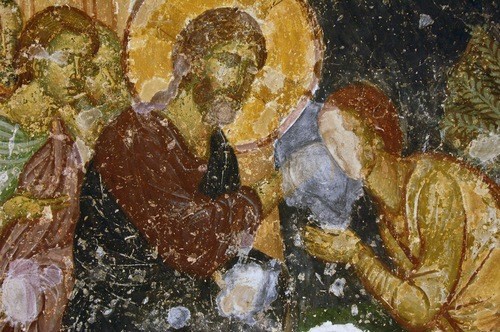
Jesus Heals the Man Born Blind (John 9), a fresco in the west narthex of the Hagia Sophia Church in Trabzon, Turkey1.
For the best copy of this Meditation, with all formatting in place, click here for the PDF:
John 9 (NJB): 6 Having said this, he spat on the ground, made a paste with the spittle, put this over the eyes of the blind man, 7 and said to him, ‘Go and wash in the Pool of Siloam (the name means ‘one who has been sent’). So, he went off and washed and came back able to see.2
Laetare (“Rejoice!”) Sunday
We have taken our cue from the Gospels given to be heard and contemplated in Catholic churches on each of the Sundays of Lent. We have progressed from Temptation (Matthew 4) to Transfiguration (Matthew 17) to Conversation (John 4) and now to Conflict (John 9). And this particular Sunday is called Laetare Sunday:
Seeing the Painting
First, this fresco4 was painted sometime in the second half of the 13th century, which leaves us unsurprised at the water damage.
Why would we choose to contemplate this representation of that remarkable story in John 9? Because the 750 years of wear on that fresco makes us unable to see it (we see partially); we are blind. Isn’t it interesting that the very thing that we want to be able to see – Jesus touching the eyelids of the man born blind and the expression on the man’s face as this happened – has become hidden?
When we are unable to see something that we want to see, we pay far closer attention to it. We cease to use our eyes only and bring into play our powers of imagination and intellect as we work to “make sense” of what we can see and what we cannot yet make out. Seeing is never about merely the eyes.5
Laetare (“Rejoice!”) Sunday
We have taken our cue from the Gospels given to be heard and contemplated in Catholic churches on each of the Sundays of Lent. We have progressed from Temptation (Matthew 4) to Transfiguration (Matthew 17) to Conversation (John 4) and now to Conflict (John 9). And this particular Sunday is called Laetare Sunday:
Laetare Sunday - The Fourth Sunday in Lent (‘Mid-Lent Sunday’, Mi-carême), so named from the opening words of the Introit at the Mass (Is. 66:10, ‘Rejoice with Jerusalem’). In W. Christendom certain relaxations of the penitential observances of Lent are allowed, e.g. the wearing of rose-pink instead of purple vestments. The Sunday is also known as Mothering Sunday and Refreshment Sunday.3
Seeing the Painting
First, this fresco4 was painted sometime in the second half of the 13th century, which leaves us unsurprised at the water damage.
Why would we choose to contemplate this representation of that remarkable story in John 9? Because the 750 years of wear on that fresco makes us unable to see it (we see partially); we are blind. Isn’t it interesting that the very thing that we want to be able to see – Jesus touching the eyelids of the man born blind and the expression on the man’s face as this happened – has become hidden?
When we are unable to see something that we want to see, we pay far closer attention to it. We cease to use our eyes only and bring into play our powers of imagination and intellect as we work to “make sense” of what we can see and what we cannot yet make out. Seeing is never about merely the eyes.5
The Oxford English Dictionary at “to gawk” – colloquial, originally U.S. or dialect. 1. 1785 – intransitive. To stare or gape stupidly6.
Consider, then, this spiritual principle: When we understand, and fully accept, that we are blind, we become more fully awake and focused. We cease gawking at the world, and we learn to work at seeing, the practice7 of attention, discovering that it is harder than we thought to win this habit.
We are blessed, not cursed, when we are shown and can accept how blind we are.
John 9 (NJB): 40 Hearing this, some Pharisees who were present said to him, ‘So we are blind, are we?’ 41 Jesus replied:
If you were blind,
you would not be guilty,
but since you say, ‘We can see,’
your guilt remains.8
Second, did you notice that tiny wrist and hand reaching out toward Jesus, the owner of which is also obscured by water damage (bottom center of the fresco)? We suspect a cherub hidden there.
The Oxford English Dictionary at “cherub” – 2.b. – 1382 – One of the second order of angels of the Dionysian [Dionysius the Areopagite, fl. 500 CE]9 hierarchy, reputed to excel specially in knowledge (as the seraphim did in love); a conventional representation of such an angelic being in painting or sculpture.
But what if the painter (placing himself into this scene as the blind man) was a dad of a newborn. Might he have painted that cherub there as an image of his own child? Perhaps he was a dad, who was keenly aware of his blindness (not of the eyes) and of his limitations (what dad does not feel that?) and of his need for Christ.
Perhaps as he painted on the ceiling of that church, high up there on the scaffolding in the west narthex, he prayed that his child would come to know Christ and to reach for Him (see the hand reaching?), imitating his dad who also is reaching toward Jesus.
A contemplative reading of a biblical text will cause such thoughts and associations and connections to enter our prayer. We should learn to let that happen, asking the Spirit to teach us through the sacred text.
Quotes
Pope Francis I (1936-2025; pope from 13 March 2013)12 in his Interview by Fr. Anthony Spadaro, SJ (30 September 2013)13, published in America magazine (Jesuit) - “I see clearly,” the pope continues, “that the thing the church needs most today is the ability to heal wounds and to warm the hearts of the faithful; it needs nearness, proximity. I see the church as a field hospital after battle. It is useless to ask a seriously injured person if he has high cholesterol and about the level of his blood sugars! You have to heal his or her wounds. Then we can talk about everything else. Heal the wounds, heal the wounds. … And you have to start from the ground up.” [My emphasis.]
John 9 (NJB): 35 Jesus heard they had ejected him, and when he found him he said to him, ‘Do you believe in the Son of man?’ 36 ‘Sir,’ the man replied, ‘tell me who he is so that I may believe in him.’ 37 Jesus said, ‘You have seen him; he is speaking to you.’10
Perhaps as he painted on the ceiling of that church, high up there on the scaffolding in the west narthex, he prayed that his child would come to know Christ and to reach for Him (see the hand reaching?), imitating his dad who also is reaching toward Jesus.
John 1 (NJB): 35 The next day as John stood there again with two of his disciples, Jesus went past, 36 and John looked towards him and said, ‘Look, there is the lamb of God.’ 37 And the two disciples heard what he said and followed Jesus. 38 Jesus turned round, saw them following and said, ‘What do you want?’11
A contemplative reading of a biblical text will cause such thoughts and associations and connections to enter our prayer. We should learn to let that happen, asking the Spirit to teach us through the sacred text.
Quotes
Pope Francis I (1936-2025; pope from 13 March 2013)12 in his Interview by Fr. Anthony Spadaro, SJ (30 September 2013)13, published in America magazine (Jesuit) - “I see clearly,” the pope continues, “that the thing the church needs most today is the ability to heal wounds and to warm the hearts of the faithful; it needs nearness, proximity. I see the church as a field hospital after battle. It is useless to ask a seriously injured person if he has high cholesterol and about the level of his blood sugars! You have to heal his or her wounds. Then we can talk about everything else. Heal the wounds, heal the wounds. … And you have to start from the ground up.” [My emphasis.]
C.S. Lewis, “Preface” to St. Athanasius (296-373 CE)14 On the Incarnation – We may be sure that the characteristic blindness of the twentieth century - the blindness about which posterity will ask, “But how could they have thought that?” - lies where we have never suspected it, and concerns something about which there is untroubled agreement between Hitler and President Roosevelt or between Mr. H. G. Wells and Karl Barth. None of us can fully escape this blindness, but we shall certainly increase it, and weaken our guard against it, if we read only modern books. Where they are true, they will give us truths which we half knew already. Where they are false, they will aggravate the error with which we are already dangerously ill. The only palliative15 is to keep the clean sea breeze of the centuries blowing through our minds, and this can be done only by reading old books.16 [My emphasis.]
Lauren Hillenbrand, Seabiscuit (published 1999) – “You don't throw a whole life away just because it's banged up a little bit.”17
Thoughts
First, Consider the significance of names. When you read this masterpiece of a story – John 9:1-40 – it is worth noticing where one’s attention lands in the story. I have noticed that often the name of a biblical story can pull my attention away from where my attention is fixed. (Think of that famous parable in Luke 15 when some renamed it “The Prodigal Father” rather than “The Prodigal Son”.)
Lauren Hillenbrand, Seabiscuit (published 1999) – “You don't throw a whole life away just because it's banged up a little bit.”17
Thoughts
First, Consider the significance of names. When you read this masterpiece of a story – John 9:1-40 – it is worth noticing where one’s attention lands in the story. I have noticed that often the name of a biblical story can pull my attention away from where my attention is fixed. (Think of that famous parable in Luke 15 when some renamed it “The Prodigal Father” rather than “The Prodigal Son”.)
Scholars give a name to a biblical story,18 doing so to be helpful, to remind the reader, “Oh, it is that story that I am about to read.” We come to appreciate the help of having those boldfaced titles inserted above each distinct piece of text.
However, such titles or names for a story can overly affect what one pays attention to in the story. For example, when this story is named “The Man Born Blind” it keeps one’s attention focused on this man, and on the circumstance of his sightless eyes, something for which he was not responsible. But does focusing on the fact that he was “born blind” really get to point of the story? Is it not a much richer reading of the story to pay attention to what happened in that man once his sight was restored? How might the story do its good work in us if it were named, “A Man who Learns the Price of Really Seeing”?
What do you think should be the name for this story?
Second, when the blind man meets Jesus for the first time, he knows Him only through His voice and the touch of His fingers on his eyelids. He has no idea what Jesus looks like, which is interesting. And so, when he returns from the pool of Siloam, his face bright with seeing eyes, would he not desire to find who it was who had accomplished something so life-changing for him and for his family? But, again, the man has no idea what Jesus looks like. (The theme of the Son of God hidden in plain sight is ubiquitous in the Gospels – “Who do you say that I am?”.)
Let us consider, then, how often we ignore someone, being not interested in what he or she has to say, because his or her looks put us off. Yet it would not be unlike God at all to give to that unlovely person the words we most need to hear. Isn’t it true that, if we were honest, we have made sure that Jesus in our imagination is just the right degree of handsome? We should consider why we do that.
Perhaps we could find Jesus much closer to us than we imagine possible if we shut our eyes and paid closer attention to what we hear people say. The blind man was saved because of what he heard, not by what he saw.
Third, and finally, in our current American moment, we feel often a considerable danger to friendship if we told someone that he or she is blind, preferring a deep-set bias to a more expansive truth. “Who are you to say this to me?!”, they would furiously riposte. Or in our story here:
However, such titles or names for a story can overly affect what one pays attention to in the story. For example, when this story is named “The Man Born Blind” it keeps one’s attention focused on this man, and on the circumstance of his sightless eyes, something for which he was not responsible. But does focusing on the fact that he was “born blind” really get to point of the story? Is it not a much richer reading of the story to pay attention to what happened in that man once his sight was restored? How might the story do its good work in us if it were named, “A Man who Learns the Price of Really Seeing”?
What do you think should be the name for this story?
Second, when the blind man meets Jesus for the first time, he knows Him only through His voice and the touch of His fingers on his eyelids. He has no idea what Jesus looks like, which is interesting. And so, when he returns from the pool of Siloam, his face bright with seeing eyes, would he not desire to find who it was who had accomplished something so life-changing for him and for his family? But, again, the man has no idea what Jesus looks like. (The theme of the Son of God hidden in plain sight is ubiquitous in the Gospels – “Who do you say that I am?”.)
Let us consider, then, how often we ignore someone, being not interested in what he or she has to say, because his or her looks put us off. Yet it would not be unlike God at all to give to that unlovely person the words we most need to hear. Isn’t it true that, if we were honest, we have made sure that Jesus in our imagination is just the right degree of handsome? We should consider why we do that.
Perhaps we could find Jesus much closer to us than we imagine possible if we shut our eyes and paid closer attention to what we hear people say. The blind man was saved because of what he heard, not by what he saw.
Third, and finally, in our current American moment, we feel often a considerable danger to friendship if we told someone that he or she is blind, preferring a deep-set bias to a more expansive truth. “Who are you to say this to me?!”, they would furiously riposte. Or in our story here:
John 9 (NJB): 32 Ever since the world began it is unheard of for anyone to open the eyes of a man who was born blind; 33 if this man were not from God, he wouldn’t have been able to do anything.’ 34 They retorted, ‘Are you trying to teach us, and you a sinner through and through ever since you were born!’ And they ejected him.19
We human beings were designed by God to be good at not knowing. God built us to learn from the experiences and insights of others, of all others20 if we have the audacity21 to be that teachable.
From the movie Contact (released 1997) –
The alien on Vega speaking to Ellie Arroway: “You're an interesting species, an interesting mix. You're capable of such beautiful dreams and such horrible nightmares. You feel so lost, so cut off, so alone, only you're not. See, in all our searching, the only thing we've found that makes the emptiness bearable is each other.”
Ellie Arroway’s testimony: “For as long as I can remember, I've been searching for something, some reason why we're here. What are we doing here? Who are we? If this is a chance to find out even just a little part of that answer... I don't know, I think it's worth a human life. Don't you?”
Prayer for the Fourth Sunday of Lent (Laetare Sunday)22
O God, who through your Word
reconcile the human race to yourself in a wonderful way,
grant, we pray,
that with prompt devotion and eager faith
the Christian people may hasten
toward the solemn celebrations to come.23
Notes
1 The most famous Hagia Sophia church is in Istanbul.
2 The New Jerusalem Bible. Doubleday, 1990, p. Jn 9:6–7.
W. West, Western
3 Louth, Andrew, editor. “Laetare Sunday.” The Oxford Dictionary of the Christian Church, Fourth Edition, vol. 2, Oxford University Press, 2022, p. 1090.
4 The Oxford English Dictionary at “fresco” – 2.a. – 1598 – A kind of painting executed in watercolor on a wall, ceiling, etc. of which the mortar or plaster is not quite dry, so that the colors sink in and become more durable. Originally in phrase “(to paint) in fresco”.
5 Did you notice how the religious “experts” in the Temple had perfectly good eyes. It was their stubborn refusal to let their intellects be “opened” (were self-blinded) by something genuinely new and astonishing and beautiful happening right in front of them. Their eyes worked just fine; their intellects were the problem – “darkened”. John 3:
2 The New Jerusalem Bible. Doubleday, 1990, p. Jn 9:6–7.
W. West, Western
3 Louth, Andrew, editor. “Laetare Sunday.” The Oxford Dictionary of the Christian Church, Fourth Edition, vol. 2, Oxford University Press, 2022, p. 1090.
4 The Oxford English Dictionary at “fresco” – 2.a. – 1598 – A kind of painting executed in watercolor on a wall, ceiling, etc. of which the mortar or plaster is not quite dry, so that the colors sink in and become more durable. Originally in phrase “(to paint) in fresco”.
5 Did you notice how the religious “experts” in the Temple had perfectly good eyes. It was their stubborn refusal to let their intellects be “opened” (were self-blinded) by something genuinely new and astonishing and beautiful happening right in front of them. Their eyes worked just fine; their intellects were the problem – “darkened”. John 3:
19 And the judgement is this:
though the light has come into the world
people have preferred
darkness to the light
because their deeds were evil.5
6 “stupidly” – Recall that when a person is being “stupid”, it means that he or she has a mind but cares not to use it, to train it, to make demands on it. This is why people who are passionate about “issues”, and are proud that they are, often strike us as remarkably capable of avoiding the demands and discipline of intellect, the humility required to work something out and with the help of others.
7 The Oxford English Dictionary at “to practice” – 2.a. - ?a1425 – intransitive. To exercise oneself in a skill or art in order to acquire or maintain proficiency, esp. in music. Frequently with on.
8 The New Jerusalem Bible. Doubleday, 1990, p. Jn 9:40–41.
9 Dionysius (6) the Areopagite (c.500) Liturgical and mystical theologian. … The aim of all Dionysius’ works is the union of the whole created order with God, which union is the final stage of a threefold process of purification, illumination, and perfection or union: a triad which has been vastly influential in the Christian mystical tradition. The way to such union (ἓνωσις) with God, or deification (θέωσις) as Dionysius is fond of calling it, has several aspects. [Louth, Andrew. “Dionysius (6) the Areopagite.” The Oxford Dictionary of the Christian Church, edited by Andrew Louth, Fourth Edition, vol. 1, Oxford University Press, 2022, p. 556.]
7 The Oxford English Dictionary at “to practice” – 2.a. - ?a1425 – intransitive. To exercise oneself in a skill or art in order to acquire or maintain proficiency, esp. in music. Frequently with on.
8 The New Jerusalem Bible. Doubleday, 1990, p. Jn 9:40–41.
9 Dionysius (6) the Areopagite (c.500) Liturgical and mystical theologian. … The aim of all Dionysius’ works is the union of the whole created order with God, which union is the final stage of a threefold process of purification, illumination, and perfection or union: a triad which has been vastly influential in the Christian mystical tradition. The way to such union (ἓνωσις) with God, or deification (θέωσις) as Dionysius is fond of calling it, has several aspects. [Louth, Andrew. “Dionysius (6) the Areopagite.” The Oxford Dictionary of the Christian Church, edited by Andrew Louth, Fourth Edition, vol. 1, Oxford University Press, 2022, p. 556.]
10 The New Jerusalem Bible. Doubleday, 1990, p. Jn 9:35–37.
11 The New Jerusalem Bible. Doubleday, 1990, p. Jn 1:35–38.
12 Wikipedia – Jorge Mario Bergoglio, later Pope Francis I (born 17 December 1936 in Argentina; died 21 April 2025 in Rome) was head of the Catholic Church and sovereign of Vatican City from 13 March 2013 until his death in April 2025. He was the first Jesuit pope, the first Latin American, and the first born or raised outside Europe since the 8th-century Syrian pope Gregory III.
13 See: https://www.americamagazine.org/faith/2013/09/30/big-heart-open-god-interview-pope-francis/.
11 The New Jerusalem Bible. Doubleday, 1990, p. Jn 1:35–38.
12 Wikipedia – Jorge Mario Bergoglio, later Pope Francis I (born 17 December 1936 in Argentina; died 21 April 2025 in Rome) was head of the Catholic Church and sovereign of Vatican City from 13 March 2013 until his death in April 2025. He was the first Jesuit pope, the first Latin American, and the first born or raised outside Europe since the 8th-century Syrian pope Gregory III.
13 See: https://www.americamagazine.org/faith/2013/09/30/big-heart-open-god-interview-pope-francis/.
14 St. Athanasius of Alexandria (296-373 CE) – “Black Dwarf” was the tag his enemies gave him. And the short, dark-skinned Egyptian bishop had plenty of enemies. He was exiled five times by four Roman emperors, spending 17 of the 45 years he served as bishop of Alexandria in exile. Yet in the end, his theological enemies were “exiled” from the church’s teaching, and it is Athanasius’s writings that shaped the future of the church. (From 131 Christians Everyone Should Know.)
15 The Oxford English Dictionary at “palliative” – 1.a. - ?a1425 – That relieves the symptoms of a disease or condition without dealing with the underlying cause.
16 Lewis, C. S. “Preface: From the First Edition.” On the Incarnation: Translation, edited & translated by John Behr, vol. 44a, St Vladimir’s Seminary Press, 2011, p. 13.
17 I am grateful to my friend Fr. Gary Uhlenkott, SJ not only for this quote but how he read it to me, the feeling and deep understanding he expressed.
15 The Oxford English Dictionary at “palliative” – 1.a. - ?a1425 – That relieves the symptoms of a disease or condition without dealing with the underlying cause.
16 Lewis, C. S. “Preface: From the First Edition.” On the Incarnation: Translation, edited & translated by John Behr, vol. 44a, St Vladimir’s Seminary Press, 2011, p. 13.
17 I am grateful to my friend Fr. Gary Uhlenkott, SJ not only for this quote but how he read it to me, the feeling and deep understanding he expressed.
18 These names are not inspired Scripture; they were not given their names by God. And as you have seen, different biblical translations name the same story differently than others, but sometimes adopting the same name that others prefer.
19 The New Jerusalem Bible. Doubleday, 1990, p. Jn 9:32–34.
20 This idea lies at the heart of what “higher” education means. “Higher” was originally intended to mean “more broadly knowledgeable and capable”, making a person unafraid of remaining habitually teachable. I think it was and remains a significant loss when “higher” education came to mean hyper-specialized – knowing (thoroughly) more and more about less and less – and exposed to the apparently unavoidable temptation to arrogance. That is why “higher” education, and in significant degree as developed by the Jesuits in the 16th and 17th centuries, was what liberal education meant; that is, a “freeing” education, an education that fully activates a person’s powers of soul, which makes him or her always capable of learning, teaching him or her to care for meaning and committed to the common good of all.
21 The Oxford English Dictionary at “audacity” – 1.a. – 1432 – Boldness, daring, intrepidity; confidence.
22 Deus, qui per Verbum tuum
humáni géneris reconciliatiónem mirabíliter operáris,
præsta, quǽsumus, ut pópulus christiánus
prompta devotióne et álacri fide
ad ventúra sollémnia váleat festináre.
Per Dóminum.22
23 The Roman Missal: Renewed by Decree of the Most Holy Second Ecumenical Council of the Vatican, Promulgated by Authority of Pope Paul VI and Revised at the Direction of Pope John Paul II. Third Typical Edition, United States Conference of Catholic Bishops, 2011, p. 246.
19 The New Jerusalem Bible. Doubleday, 1990, p. Jn 9:32–34.
20 This idea lies at the heart of what “higher” education means. “Higher” was originally intended to mean “more broadly knowledgeable and capable”, making a person unafraid of remaining habitually teachable. I think it was and remains a significant loss when “higher” education came to mean hyper-specialized – knowing (thoroughly) more and more about less and less – and exposed to the apparently unavoidable temptation to arrogance. That is why “higher” education, and in significant degree as developed by the Jesuits in the 16th and 17th centuries, was what liberal education meant; that is, a “freeing” education, an education that fully activates a person’s powers of soul, which makes him or her always capable of learning, teaching him or her to care for meaning and committed to the common good of all.
21 The Oxford English Dictionary at “audacity” – 1.a. – 1432 – Boldness, daring, intrepidity; confidence.
22 Deus, qui per Verbum tuum
humáni géneris reconciliatiónem mirabíliter operáris,
præsta, quǽsumus, ut pópulus christiánus
prompta devotióne et álacri fide
ad ventúra sollémnia váleat festináre.
Per Dóminum.22
23 The Roman Missal: Renewed by Decree of the Most Holy Second Ecumenical Council of the Vatican, Promulgated by Authority of Pope Paul VI and Revised at the Direction of Pope John Paul II. Third Typical Edition, United States Conference of Catholic Bishops, 2011, p. 246.
Posted in Lenten Meditations
Recent
Categories
Tags
Archive
2026
January
February
March
2025
January
March
June
October
2024
January
March
September
October
2023
March
November
2022
2021
2020
No Comments